A medieval survival game of war, whispers,
and the slow poison of power
Four lords. One vast, uncharted world. Dense forests hide armies. Mountain passes conceal ancient treasure. Seas connect distant islands no one has mapped yet. Every crow that passes overhead has seen something you haven’t.
The realm was broken before you arrived. There is no king. There may never be one again — unless someone earns it. The world does not wait for you to be ready.
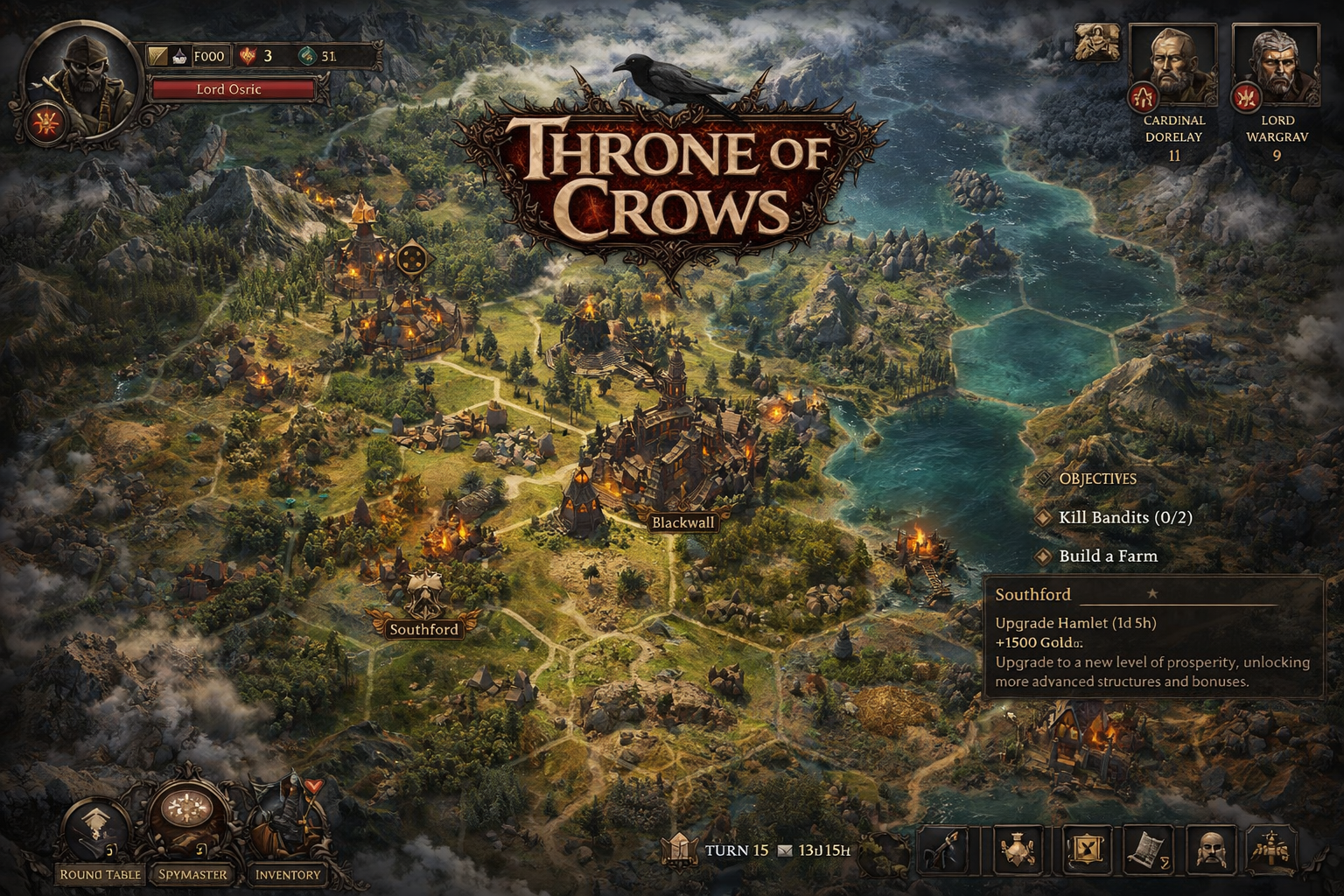
Turn 15 — Lord Osric surveys the realm from Blackwall — The spymaster awaits
You are dropped blind onto a massive procedurally generated map. Scout on foot, by horse, by boat. Every fog-of-war tile could contain treasure, ruin, or an enemy’s hidden fort.
Raise taverns and markets. Build walls. Forge a castle stone by stone. Recruit named followers — each with their own story, skills, and secrets. Deploy a spy. Hire a Carpenter. Find a Sage.
Form alliances at the Round Table. Share intelligence. Make promises. Break them at exactly the right moment. Or don’t — and watch someone do it to you first, with a follower you trusted.
A whisper arrives from your spy in the east. Lord Aldric has been buying grain in bulk for three weeks. His carpenter was seen at the coast. Whatever he is building, it is large, and it is near water.
Across the table, your archer Edmund will not meet your eyes.
You have two turns before Aldric’s fleet is ready. You have one gold piece left. And someone in your Round Table is not who they say they are.
Most games force one way to win. Throne of Crows gives you two — and they demand completely opposite playstyles. Every choice you make pushes you further down one path and further from the other.
Eliminate every rival from the map. Build armies. Besiege their castles. Leave nothing standing. You will be feared across the realm. You will never be loved. And you will never be voted King.
Earn the trust of your rivals. Build prosperity. Protect the weak. Campaign your court. When you declare candidacy, the surviving lords vote. They cannot vote for themselves. You need their belief — or their fear of someone worse.
A King who turns tyrant can be challenged and dethroned. The game isn’t over when the crown lands.
Edmund the miller’s son. He never talked about the fire. He fought with controlled fury and always watched your back. Then he stepped in front of the wrong arrow. His name is greyed out now with a note of where he fell.
Followers are not units. They are named individuals with backstories, personality traits, and secrets. When they die, you feel it. When they betray you, you remember it for the rest of the game.
You called the council to share intelligence. Everyone you trust is in the room. What you don’t know is that one of them isn’t who they say they are. Every word spoken here reaches your enemy before morning.
A private council chamber for alliances, war plans, and kingship campaigns. The most powerful space in the game — and the most exposed. A turned follower in your Round Table hears everything.
Smoke to the north. A merchant who saw soldiers moving at night. A hermit who heard chopping from the forest for three days. None of it means anything alone. Together, it means someone is building a fleet, and you have two turns.
Whispers return incomplete. The lord who assembles the fragments correctly outplays the one who ignores them. The one who acts on forged intelligence loses everything.
You suspect a follower. You accuse them before the full council. They cannot speak in their own defence. The vote condemns. The execution is immediate. You discover, too late, that you were wrong. The real spy is still at the table.
Word travels. Loyalty scores drop quietly. Towns hear about it. Respected reputation falls. And somewhere in the dark, the real spy sends a report: He trusts no one now. He is isolated and afraid.
It is 2am. You are not playing. But you are thinking about where Aldric’s fleet is. You are wondering whether your spy in the eastern market has reported back yet. You are composing the raven message you will send in the morning.
Take your turn when ready. Pre-plan. Set spies in motion. Set patrol orders for your followers. The obsession is the point.
The Spymaster has been silent for six turns. You haven’t seen her forces move. But your informant in the northern market says she was there last week, asking questions about you specifically.
Play solo or with any mix of human and CPU lords. The Builder, the Raider, the Diplomat, the Hermit, the Spymaster — each pursues their own strategy using the same systems as human players. The game is never empty.
When the stakes are high enough, words on parchment won’t do. Any lord can call a Round Table meeting — a live video council where all willing lords appear face to face across the ancient stone table. Treaties are forged here. Alliances declared. Wars averted or ignited. Every word spoken is heard by everyone present. Choose yours carefully.
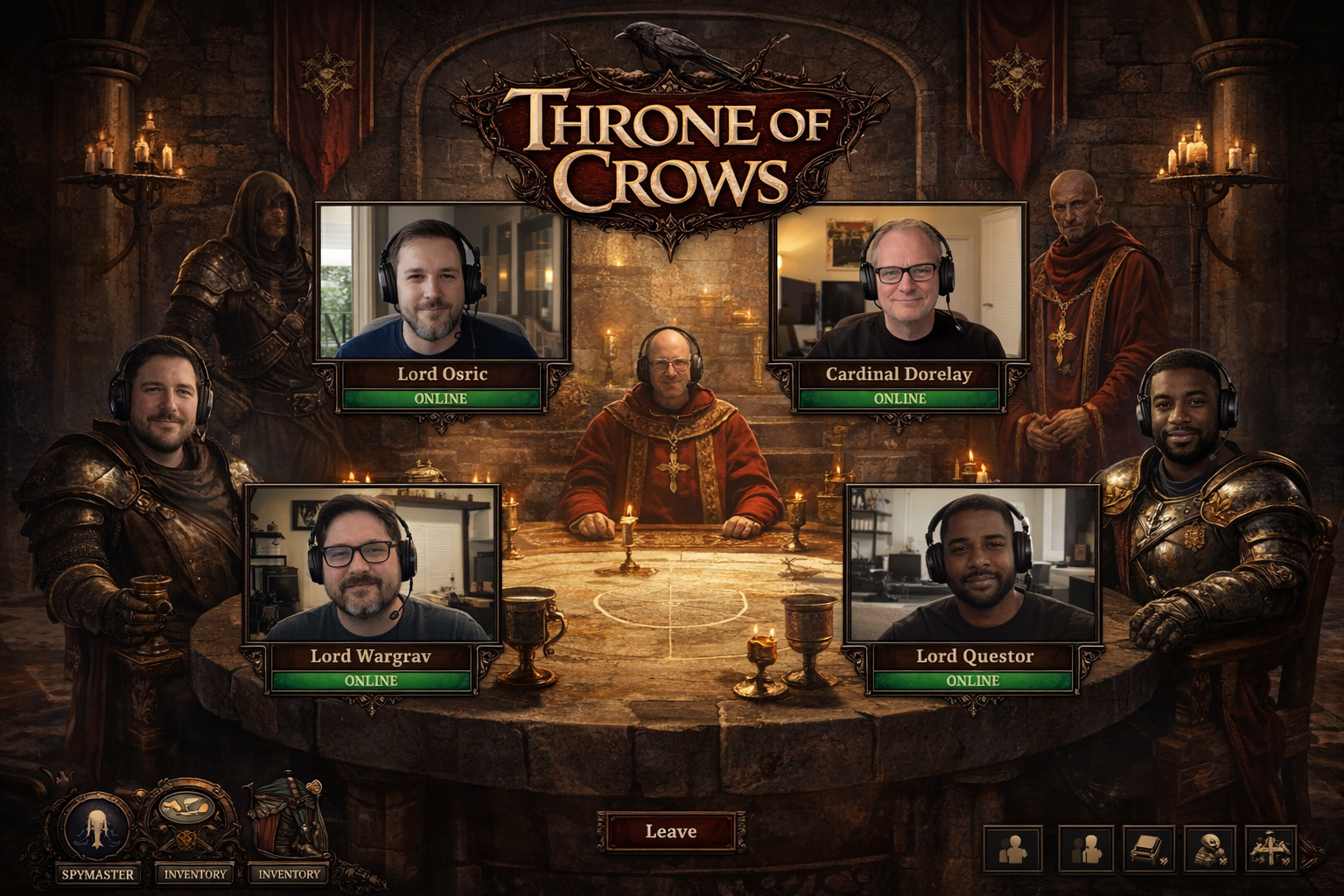
The Round Table convenes — Lord Osric, Cardinal Dorelay, Lord Wargrav, Lord Questor — all online
Propose treaties, trade agreements, and mutual defence pacts face to face. The pressure of a live conversation changes everything. It is much harder to lie to someone’s face.
A formal declaration. An ultimatum. An apology. Some moments in the game demand a human voice. Call the council, state your terms, and let the other lords decide how to respond.
The meeting is optional. A lord who refuses the summons sends a message of their own. Presence is diplomacy. Absence is also a choice — and everyone at the table will remember it.
Attendance is never compulsory. What is said in the council chamber is witnessed by all who attend — but the spy in your ranks hears every word. Invite wisely.
CPU lords are not diminished opponents. They use the same spy networks, alliances, and building systems as human players. Each has a personality that shapes every decision they make.
Hard to attack. Slow to threaten. But let them build long enough and you cannot touch them.
Viking aggression. Fast boats. Hit and run. Accumulates gold through plunder and vanishes before you can retaliate.
Courts alliances aggressively. Campaigns for kingship. Avoids open warfare. Terrifyingly close to winning when you notice.
Retreats to mountains. Accumulates rare discoveries. Strikes late with devastating resources you didn’t know existed.
Knows where you are. Knows what you have. Knows what you are about to do. Acts on information you never realised you leaked.
Every crown in history was built on something that should not have been done. The crows remember. They always do.
Four players. One realm. No second chances.
Beta access by invitation only. If you were meant to be here, you already know.